FIELD NOTES · 01
Set your eyes on the landing
Death Spiral is a single-player horror roguelike organized around one action and a rotating pointer. The pointer keeps changing your opportunity. Your input commits to the opportunity that exists at that moment. Begin by treating the pointer as information about where the next move will put you. If you watch only the button prompt and react as soon as it appears, you can miss an enemy or a worse position in the direction you chose.
Observe a full rotation when the opening gives you time. Choose one plausible landing and watch when the pointer approaches it, passes it, and comes around again. The aim of that observation is to learn how much of the circle you can comfortably read. If you cannot name a useful direction before the pointer reaches it, the next safe opportunity may be easier to use. As pressure increases, you will have less time to wait for a perfect line. Build a habit of recognizing more than one move that would keep the run alive.
FIELD NOTES · 02
Read the Death Spiral pointer
The same failed landing can have two causes. Your plan could have been good but your input came before the usable part of the rotation. Or you may have chosen an angle that had stopped being safe while you waited. When a move surprises you, remember the position of the pointer at the moment you pressed. Compare what you expected with the direction you actually went. That gives you an adjustment you can attempt on the next cycle.
When training timing, pick a simple opening and use a single intentional input. In a later run, change your timing slightly while keeping the target similar. Check whether the move now puts you where you expected. If movement and danger still seem hard to separate, watch a short gameplay clip for exactly one decision, then return to the game and try a related situation. The clip can make the pointer easier to read. Your particular threat pattern and landing still determine whether that choice works.
FIELD NOTES · 03
Attack and dodge in context
Look at the marker and the space it will send you through. A choice that attacks in a useful direction may also move you toward a difficult next position. A dodge that avoids a current threat may leave you very little space to read the next rotation. Good play takes both pieces of information into account. Before you commit, ask what the move solves and what it makes harder immediately after.
Sometimes a modest change in position buys the next reading window. If every obvious option seems dangerous, compare nearby places by the number of follow-up directions you can see. Choose one that leaves a way out rather than going straight toward the largest area on the screen by habit. This observational method also applies when your previous move worked. Check whether that successful landing is safe for another cycle, since the surrounding pattern may change while you watch the pointer.
FIELD NOTES · 04
Practise under rising pressure
Early in an attempt, focus on one common sequence: see a threat, choose a landing, then confirm what changed when you arrived. Once that sequence feels natural, try making the decision slightly earlier. The danger does not wait for you to finish thinking about all options. Plan one good choice while the pointer is still approaching and keep one fallback for cases where the line changes.
Use repeated attempts to learn one failure pattern at a time. If you keep pressing before the target direction comes around, practise patience in a quieter part of the run. If you lose a safe opening because you keep checking every threat, practise committing to the first direction that meets a basic safety check. If you land safely but lose on the next cycle, shift your attention outward sooner after contact. These are distinct problems that benefit from distinct practice.
FIELD NOTES · 05
Timing practice in Death Spiral
Start the gameplay clip below and stop at a moment shortly before an input. Identify where the moving pointer is headed and choose the move you would attempt. Resume for just long enough to see what the player does and where they end up. Ask whether you would have chosen a different direction or simply pressed at a different time. Repeat once with a later segment and see whether faster danger changed your answer.
When you return to the player, try the observation with a fresh run. Keep the game focused so that your inputs reach the correct place. If inputs seem unreliable, check whether the frame has focus and try the standalone window. A video can look smoother than gameplay on your device. Allow for that by learning the timing in the actual build and avoiding assumptions based on the exact frame you saw in the clip.
FIELD NOTES · 06
Choose a comfortable way to practise
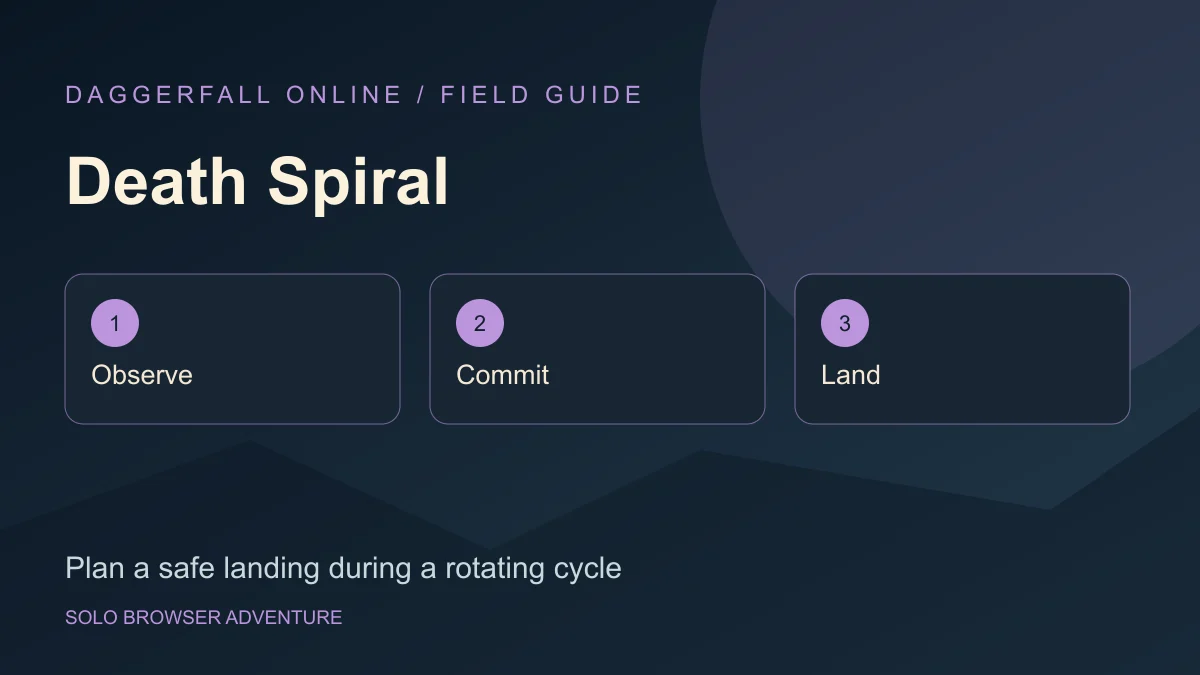
The visual style includes effects and escalating tension. Start with a short attempt if you are sensitive to flashing or find the moving pointer difficult to follow. End the session when you need a break. You can study the guide's static diagram to understand the idea without running the game. Fullscreen can make the pointer easier to see, while the embedded view makes switching back to the guide quicker. Pick the one that lets you see the target without straining.
Give yourself a small aim for the next attempt, such as making two moves with a destination chosen in advance. That target is specific enough to measure even if your final score falls. The checklist records your observation on this page during the visit. It can remind you to prepare each step, but the in-game result remains the relevant record for the run.
FIELD NOTES · 07
Compare risks while the marker is moving
When you see a good angle, notice which alternatives remain open. A direction that sends you into unoccupied space may leave you near a threat by the next decision. An angle that brings you near a threat can still be useful if it opens a side you can leave quickly. Start by comparing only two candidate directions. Pick one relatively obvious safe space and one fallback. That manageable comparison keeps your attention available for timing.
At the beginning of a practice run, try deciding your first destination as soon as you understand the visual cue. When the pointer gets close, verify that the destination still looks usable. If it does, commit and check your position right after the move. If it no longer does, use the fallback or look at the next opportunity. It is easy to lock onto the first target and ignore changes that happen while waiting. The final check is deliberately quick, and you can drop it into a faster run once the basic habit feels natural.
In a second trial, pay special attention to the move following your first safe landing. The goal is to be already looking for another escape as the new cycle begins. If you keep losing in the same place just after a successful move, you have isolated a preparation failure worth working on.
FIELD NOTES · 08
Debug a failed move from the result backward
Begin with the landing you remember. Name the visible hazard that mattered, the direction you attempted, and whether the last input came early, on time or late relative to what you wanted. If you cannot recall enough, slow the exercise down on the next fresh attempt and pay attention only to those three observations. You can stop the exercise after a single decision. There is no need to reach an advanced pattern to learn how the beginning works.
A run that ends shortly after an input can be a timing miss, a route miss, or a follow-up miss. The first is a movement at a different angle than intended. The second is the intended movement toward an insufficiently safe location. The third is a good landing with no next action planned. Choose one likely cause before you retry. Practise input alignment on a simple angle, route choices on a calm stretch, or the next read after an ordinary landing. Making the correction specific keeps you from changing three decisions at the same time.
If increasing speed makes the screen feel chaotic, return to the pointer and one destination. The skill is recognizing the information you need before pressing. You can add more details when that basic perception feels stable, such as which neighboring threat is growing or when a dodge opens a following attack.
FIELD NOTES · 09
Train with a short prediction log
For three attempts, write down your prediction for a move before you try it, using just a few words. Afterward add the outcome you saw. Look for predictions that disagree with what occurred. If the predicted direction was wrong, return to pointer reading. If the direction was right and the run still ended, examine the landing. The log is a voluntary practice tool with no game's score or browser data required.
Do the first log entry during a quiet opening. If you try to write while the action is still running, you will divide your attention just when the marker needs it. Use the end of the attempt to make your note. Try a second entry while watching the clip, where you can stop the frame and study the approach. Then return to your own run and see whether you can recognize the same kind of opportunity without a pause. One accurate prediction is enough to finish the exercise.