FIELD NOTES · 01
Read the flower and work backward
Season Shift is a solo pixel puzzle about foraging for flowers in a world you can rearrange. A flower can be visible from the start and still be out of reach. Instead of trying the nearest jump again and again, start your search from the flower. Find the ledge from which you could actually reach it. Then look for the approach to that ledge. Somewhere between your starting position and that approach there will usually be a connection to investigate.
Use the edges of the visible terrain, a raised platform or a tree as a landmark. The landmarks help you compare the same area after a change without trying to remember an entire picture. If the puzzle has a label for the season or shifts the size of the visible space, pause and reorient yourself. Find the character, flower and nearest possible landing again. A changed view can make a familiar route look like a new one.
FIELD NOTES · 02
Season Shift movement and shifters
Walk to the point that invites a world shift and read the active prompt. The hosted keyboard and touch hints can differ by input method. Decide what you want the shift to help you reach before you use it. Then watch one object or platform to see where it moves relative to your landmark. If the effect is hard to see immediately, scan outward from the character to the first blocked section of your route.
A shift can create a bridge in one place and remove a convenient step somewhere else. Once you see a new connection, check whether you can get to it from your current position. Draw the route mentally as a few short steps. If a connection opens far away but you can no longer reach it, the interesting question is where you need to stand or which intermediate connection you can use. Trying one shift at a time makes those details easier to follow.
FIELD NOTES · 03
Distinguish a route problem from a jump problem
To assess a jump, first check that both ledges exist in the current arrangement. Compare their height and the space around them. If you keep touching the side of a distant platform without reaching it, look for a closer landing that can become available after a shift. When the landing appears reachable but execution is awkward, give yourself room to practise from a stable starting spot. Avoid changing the layout after every missed input, because you may lose the comparison you need.
Keep track of a safe route back to the shifter whenever the level allows it. Use that path to recover after an experiment instead of resetting everything straight away. If you find yourself on the wrong side of a gap, look around the new starting area before repeating your original plan. You may have reached a different viewpoint that shows a route you could not see from the other side.
FIELD NOTES · 04
Use the route card without spoiling the puzzle
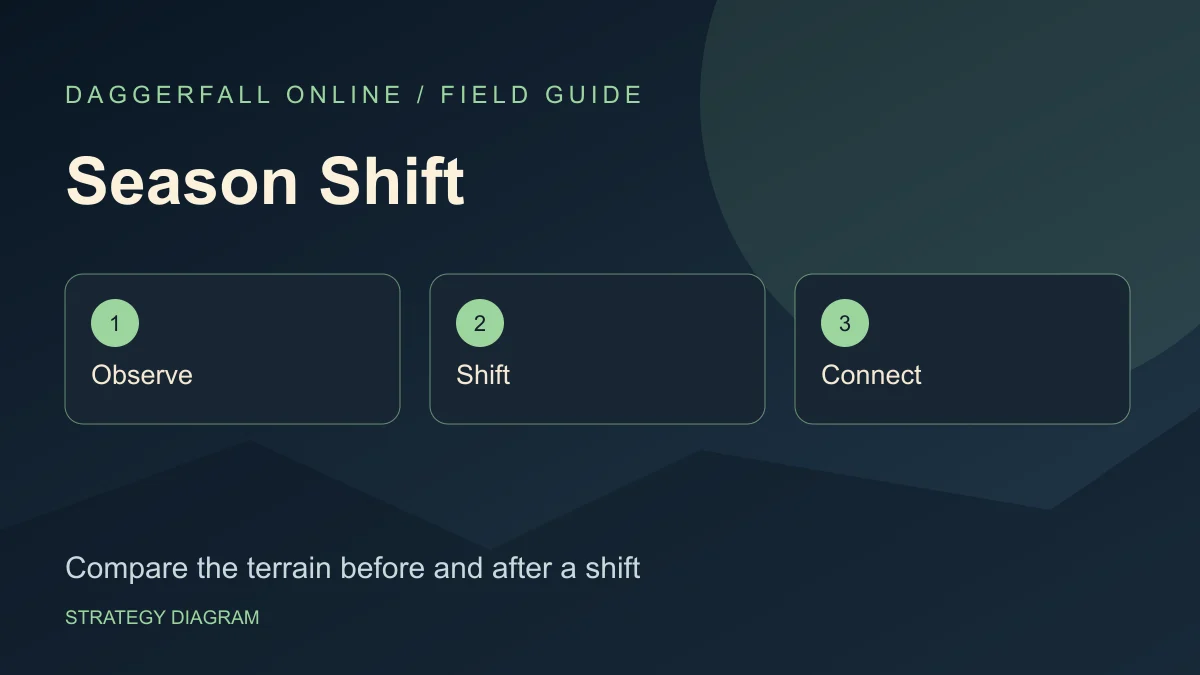
Pick a puzzle and locate the flower. In the checklist above, mark the first step only after you can point out the final approach, or explain why you cannot see one yet. Mark the second when you can name a fixed landmark and the thing you expect to move. For the third, trace a way to a safe platform or back to a usable control. These marks stay on the page while it is open. They help you remember which observation you have made while switching between the guide and the game.
If you want to help somebody else, describe which part of the level you were paying attention to. Try a hint like “Look at the height of the landing on the flower side.” Give the other player time to try a shift and compare the result. A complete sequence takes away the discovery that makes a puzzle satisfying. Two people can trade observations next to the same screen while one plays the solo game.
FIELD NOTES · 05
Collect the next flower in Season Shift
Reaching a flower advances the puzzle. Let the next room settle before carrying over the movement habits of the last one. In a wide area, scanning left to right can help you recognize the major landmarks. A narrow vertical area can make that same habit ineffective. Look for height changes, ledges stacked above one another and the location of the nearest shifter. Then make a guess about the first connection you will need.
When you have tried the same idea twice and learned nothing new, change your question. Ask what would make the final ledge reachable, which platform is fixed, or whether there is a step below the current view. This is a general way to get unstuck without revealing any particular solution. Save full walkthroughs for moments when you have exhausted your own ideas and want to continue. Watch only as far as the part of the route you need.
FIELD NOTES · 06
Make room for a square playfield
The shape of the game area is part of the puzzle experience. If you cannot see small prompts comfortably in the page, open fullscreen or use the standalone option. Keyboard focus matters on desktop: click the player before retrying movement if the surrounding page moves instead. On touch, look for the hosted controls and check whether they overlap anything you are trying to read. Turning the device can make a larger clear space for your hands, depending on the browser.
When the game starts, read its active prompt in preference to a recording from another version. The puzzle guide focuses on identifying and connecting platforms because that method transfers even when control labels differ. Return to the chapter list any time you want to find a specific observation step. The route diagram is a guide to your analysis of the room. It represents a made-up connection and leaves the actual layout for you to discover.
FIELD NOTES · 07
Sketch the room with three landmarks
Give the room a simple description you can remember after a change. Locate the flower, the shifter and a fixed feature that you can recognize when you move away. Give each one a short name in your head. Then compare the position of a moving ledge to the fixed feature. This is often enough information to follow which part of the route changed. Do not try to draw every patch of vegetation or match every pixel to the previous layout. Pick the details that decide whether you can travel from one point to the next.
Before trying the shift, predict one improvement to a route. If you think a platform will move closer to the flower, check both the gap to the flower and how you will reach that platform after it moves. When the prediction is wrong, look for the connection the change actually created. That unexpected result might be useful earlier in the route, even if it leaves the final approach unchanged. Record the conclusion in a few words or keep it in mind as you return to the shifter. One small reliable comparison is more valuable than several quickly repeated changes whose results blur together.
On a puzzle with more than one useful arrangement, name one place you can safely stand in each. It makes testing and recovery easier.
FIELD NOTES · 08
Check the return route before chasing progress
If a promising platform appears, look at what happens if your jump stops short. Would you land on a known safe patch, return to the shifter, or end up on a low ledge that forces a reset? A risky attempt can be worth making once you understand the route. During discovery, prefer exploring in a way that preserves your ability to reverse course. The information you keep from a failed test can be useful only if you remember how to reproduce the arrangement.
To compare two arrangements fairly, start from a fixed spot each time if possible. Inspect where the same ledge sits relative to the flower, then compare what movement options exist from where your character actually is. A visible connection on the far side of the screen is only one piece of the puzzle. Ask how you reach the start of that connection. If there is no obvious route, go back a step and see whether you can stand somewhere else before making the change.
When the answer turns out to be a single precise jump, use the exact same setup once or twice before concluding that the route is wrong. Give yourself a clear starting position, and make sure the game has focus. If the input feels different on touch and keyboard, test it on easy ground first.
FIELD NOTES · 09
Use a hint ladder when you want less help
Start with a broad hint you give yourself: which ledge matters most? When that does not lead anywhere, ask what the shifter moves in relation to one stationary landmark. For a final hint, trace the shortest visible line from the flower back to the new ledge and see where it breaks. This series helps you preserve discovery while still making progress. Once you collect the flower, carry the comparison method with you and inspect the next layout on its own terms.
FIELD NOTES · 10
Take a clean look at a new arrangement
If you need a fresh perspective in Season Shift, stop at a safe spot and describe the scene in order from your character to the flower. Then describe it again from the flower back to your character. Each direction emphasizes different gaps. This is particularly helpful after a transition changes the visible area. Once you can name the next gap, return to the controls and try the smallest move that gives you a better view or a more useful place to stand.